

At first glance, packing boxes for a move seems simple: you put items in boxes, close them, and load them into the truck. However, the way boxes are prepared directly affects how safely the items arrive at their destination and how easy the unpacking process will be.
A few simple rules can make a difference: distributing weight correctly, protecting fragile items, sealing boxes properly, and labeling them clearly. In this guide, you will see how to pack boxes for moving step by step so the move is more organized and safer.
In short:
- First learn how to get boxes for moving, because boxes of different sizes are essential for distributing the weight of items properly.
- Heavy items go in small boxes, while lighter items go in large boxes to avoid boxes that are impossible to lift.
- An essential step is knowing how to tape a box for moving, because a poorly sealed box can open during transport.
- Don’t leave empty spaces in boxes, because items can shift and become damaged.
- Label each box and organize the contents logically so it is clear how to organize moving boxes after arriving at the new home.
How to Get Boxes for Moving
Before you start packing your belongings, you need to have the right boxes. The quality and size of the boxes influence how safely items will be transported and how easily they can be handled.
The safest option is to use boxes specifically designed for moving. These are made from thicker cardboard and are designed to withstand heavy weight and repeated handling.
Another solution is to find free boxes from supermarkets, stores, or bookstores. In this case, check their condition carefully. The cardboard should be rigid and the corners intact. Weak or damaged boxes can easily break during transport.
In recent years, another more sustainable alternative has appeared: reusable plastic moving boxes that can be rented for a move. These are very durable, easy to stack, and eliminate the need for single-use cardboard. After the move, the boxes are collected and reused for other relocations, which makes them a popular option for people who prefer a more eco-friendly approach to moving.
For an organized move, it is important to use several box sizes. Small boxes are suitable for heavy items such as books or plates, while large boxes are better for lighter items like clothes or textiles. This weight distribution makes boxes easier to lift and reduces the risk of damage.
How to Tape a Box for Moving
Before you start placing items in boxes, it is essential to know how to tape a box for moving properly. A poorly sealed box can open during transport, especially when it is lifted multiple times or stacked inside the truck.
Professional movers almost always use the H-tape method because it provides the best stability for the box.
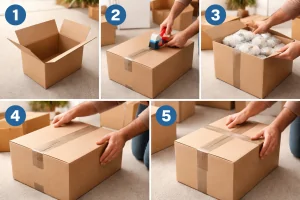
Step 1: Assemble the box and close the bottom flaps
Open the box and fold the bottom flaps so they meet in the center. Make sure the edges are properly aligned before applying the tape.
Step 2: Apply tape along the center seam
Place a long strip of tape along the center line where the flaps meet. The tape should extend slightly over the edges to fully secure the structure of the box base.
Step 3: Reinforce the sides (H-taping method)
Apply two additional strips along the side edges of the base. At this point, the tape forms the letter H, a method frequently used by professional movers to reinforce boxes.
Step 4: Fill the box and close the top
Once the box is filled and the empty spaces are padded with protective material, close the top flaps.
Step 5: Seal the top using the same H-tape technique
Apply one strip along the center seam and two more along the sides, exactly as you did on the bottom of the box. This method prevents the box from opening accidentally during the move.
An important detail is the type of tape used. Thick packing tape designed for moving provides much better strength than standard thin tape and keeps the box stable throughout transport.
How to Pack Boxes for Moving
Once the boxes are prepared and properly sealed, the next step is to understand how to pack boxes for moving so that the items are protected and the boxes can be handled easily. The way items are arranged inside the box is just as important as the type of box used.
Professional movers follow a few rules that keep boxes stable and reduce the risk of damage.
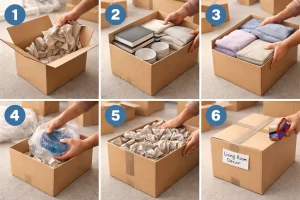
Step 1: Create a protective base layer
Before placing items in the box, add a protective layer at the bottom of the box. You can use packing paper, bubble wrap, or textiles. This layer absorbs shocks that may occur during transport.
Step 2: Place heavier items at the bottom
Heavy items should always be placed at the bottom of the box. Books, dishes, or other dense items create a stable base and prevent the contents from shifting during the move.
Step 3: Add lighter items on top
Once the base of the box is stable, lighter items can be placed on top. Clothes, textiles, or decorative items are suitable for the upper layer.
Step 4: Wrap fragile items individually
Fragile items should be wrapped individually before being placed in the box. Glasses, plates, or glass items should be protected with packing paper or bubble wrap to avoid direct contact between them.
For the kitchen, there are several specific packing techniques, since plates, glasses, and cookware are among the most fragile items in the home.
Step 5: Fill empty spaces
Empty spaces should be filled with paper, textiles, or protective material. If items can move inside the box, there is a higher risk of damage during transport.
Step 6: Close and label the box
Once the box is completely filled, close it using the correct sealing method and add a label with the room and the main contents. Proper labeling makes the unpacking process much easier in the new home.
What Not to Pack in Moving Boxes
While most items can be packed in moving boxes, there are also things that should never be placed in regular boxes. Some can become dangerous during transport, others may deteriorate quickly or create problems inside the moving truck.
Our professional movers in NYC always check these categories before a move to avoid potential risks.
Hazardous materials
Flammable or chemical products should not be packed in moving boxes. Paint, paint thinners, pressurized sprays, fuels, or strong cleaning products can become unstable during transport and may pose a risk to the moving crew.
In many cases, moving companies refuse to transport such materials for safety reasons.
Perishable food
Perishable food is not suitable for moving boxes, especially if the move takes several hours or days. Fresh, frozen, or cooked food can spoil quickly and may affect the other items in the box.
Before the move, it is recommended to consume or donate the remaining food.
Important documents and valuables
Important documents, jewelry, or valuable items should not be placed in boxes transported in the truck. They should be kept in a personal bag that stays with you throughout the move.
Business documents should be stored at a facility such as GRM.
For digital document management, consider VisualVault, an AI-powered enterprise content management platform.
Liquids that can leak
Bottles or containers with liquids may leak during transport, especially if they are pressed by other boxes. Cosmetics, detergents, or oils should be packed separately and properly protected.
In many situations, it is simpler to transport them yourself or replace them after the move.
Extremely heavy items
Very heavy items, such as large tools or bulky equipment, should not be placed in standard boxes. Excessive weight can break the box or make handling difficult for the moving crew.
Different transport and protection methods are used for these items.
To avoid common mistakes when packing your belongings for a move, it is also worth considering the golden packing rules, a few simple principles that make the entire process much safer and more efficient.
Common Packing Mistakes That Can Ruin Your Move
Overpacking boxes
One of the most common mistakes is overfilling boxes. Even though it may seem efficient to place as many items as possible in a single box, excessive weight can break the cardboard or make the box difficult to lift.
Movers recommend that a box should not exceed approximately 20–25 kg so it can be handled safely.
Mixing heavy and fragile items
Placing fragile items together with heavy objects is another common mistake. The pressure created during transport can break glass, ceramic, or decorative items.
The simple rule is that heavy items should stay at the bottom of the box, while fragile items should be protected separately.
Leaving empty space in boxes
If there is empty space inside the box, the items may move during transport. This movement is one of the main causes of damaged belongings.
Empty spaces should be filled with packing paper, textiles, or other protective materials.
Not labeling boxes clearly
Without labels, the unpacking process becomes much more complicated. Instead of quickly finding important items, you will end up opening several boxes until you find what you are looking for.
Simple labels with the room name and a short description of the contents can save a lot of time after the move.
Packing everything at the last minute
Packing in a hurry, one day before the move, almost always leads to disorganization. Fragile items are no longer protected properly, and boxes end up being filled randomly.
That is why it is helpful to start the process early and determine what to pack first when moving so that less frequently used items are packed first. This makes the move much easier to manage.
FAQ: Packing Moving Boxes
What is the best way to pack moving boxes?
The safest method is to start with a protective layer at the bottom of the box, place heavy items at the base, and lighter items on top. Fragile items should be wrapped individually, and empty spaces should be filled with paper or protective material to prevent movement during transport.
How heavy should a moving box be?
In general, a moving box should not exceed approximately 20–25 kg. Boxes that are too heavy are difficult to lift and may fail during transport. For this reason, dense items such as books are usually packed in smaller boxes.
Should I label every moving box?
Yes. Labeling each box simplifies the unpacking process. It is recommended to write the room the items came from and note if fragile items are inside.
Where can you get free boxes for moving?
Free moving boxes can be found in several places. Supermarkets, furniture stores, or electronics stores often receive deliveries in sturdy boxes that are discarded after unpacking.
What size moving boxes should I use?
It is recommended to use several box sizes. Small boxes are suitable for heavy items such as books, medium boxes for most household items, and large boxes for bulky and lightweight belongings such as clothes or textiles.
How early should you start packing before moving?
In most situations, it is best to start packing about two or three weeks before the move. Items that are rarely used can be packed first, while essential belongings can remain for the end to avoid disorganization during the last days.
Get a Free Moving Quote Today