

Moving is one of those moments when even the smallest detail can lead to damage: a furniture corner brushing against a wall, an overloaded box, a fragile item that wasn’t packed well enough. Everything happens quickly, and in the rush, it’s easy to overlook important steps.
The good news is that most of these issues can be prevented with the right materials, proper packing techniques, and a careful approach.
This guide is built on our direct, real-world experience. Years of seeing what works and what causes damage, regardless of the size of the move. We’ve gathered the most useful practices we apply every day as professional movers and turned them into a series of clear, practical steps to help ensure your belongings arrive safely at your new address.
Why does damage happen during a move?
Damage during a move doesn’t happen just by bad luck. In most cases, the causes are simple and predictable.
The most common reasons damage occurs are:
- Lack of proper materials
- Incorrect packing
- Improper handling
- Insufficient protection inside the home
- Weak or improper securing inside the truck
- Rushing
These issues can lead to significant losses or costly repairs.
Essential packing materials
Using the right materials is the most reliable way to prevent damage during a move. These are the must-have items we use in every professional relocation — and the ones we recommend to anyone who wants real protection.
Sturdy boxes in multiple sizes
- Double-wall boxes for heavy items (books, dishes, jars)
- Large boxes for textiles, pillows, and bulky items
- Small, compact boxes for dense items (bottles, cosmetics, tools)
Why it matters: thin boxes lose their shape under weight, tear at the corners, and slide when stacked.
Bubble wrap + paper padding
- Bubble wrap absorbs vibrations and protects fragile edges
- Paper padding distributes pressure and reduces the risk of chipping
We use the combination of both for irregularly shaped items or anything that may bump into other objects inside the truck.
Professional moving blankets
- The best option for furniture, large appliances, corners, and frames
- Absorb shocks, prevent scratches, and reduce vibration damage
- Don’t leave marks and don’t fall apart like household blankets
These blankets are essentially the “armor” of a proper move.
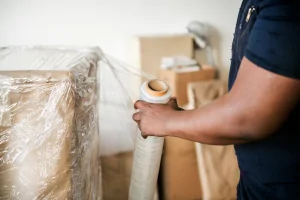
Stretch wrap
- Secures blankets to furniture and prevents slipping
- Locks doors, drawers, and appliance lids
- Provides an extra barrier against moisture and dust
Corrugated cardboard & corner protectors
- The best choice for sharp edges and large picture frames
- Add rigidity and distribute pressure on corners, which are the first to take impact during transport
High-quality packing tape
- Adheres tightly and doesn’t peel in hot or cold temperatures
- Reduces the risk of the box bottom opening when lifted
Our rule: at least two passes across the base — one straight, one perpendicular.
Mattress and sofa covers
- Prevent moisture, dust, and dirt from being absorbed
- Reduce the chance of tearing textiles when items are dragged instead of lifted
- Essential especially for rainy-day moves or tight stairways
Permanent markers for labeling
- Clear labels reduce unnecessary handling
- Movers can place boxes directly into the correct rooms, avoiding overcrowding one area
- Prevent constant rotating of boxes to see what’s inside — one of the most common causes of accidental bumps
Why we insist on these materials
This is the Moishe’s standard. We use the same materials in every professional move because they significantly reduce damage, speed up loading, and keep items stable inside the truck.
Premium boxes, moving blankets, and stretch wrap are always the foundation of a move without incidents.
Proper packing techniques
To minimize risks, in professional moves we follow a few simple but essential rules:
- Heavy items on the bottom, delicate items on top.
Bulky items form the base, while light and fragile ones stay above them to prevent excessive pressure.
- Fill every gap.
A box where you hear items shifting is a box that will cause problems. Crumpled paper, textiles, or paper padding stabilize the interior.
- Layered protection.
For fragile items, we start with a cushioning layer, place the items, then add another layer on top. It’s the safest method for absorbing shocks.
- Plates packed vertically.
They withstand vibration and lateral pressure better than when stacked flat.
- Glasses and thin items wrapped individually.
2–3 layers of paper or bubble wrap are essential to protect their edges.
- Frames and mirrors reinforced before wrapping.
A piece of rigid cardboard placed over the surface reduces the risk of cracks or pressure points.
- TVs transported only vertically.
Laying them flat is one of the most common causes of damage.
- Moderate-weight boxes.
An overly heavy box can tear — and is also dangerous to carry.
- H-shaped sealing.
This method keeps the box compact and reduces the risk of accidental opening.
- Clear, visible labels.
Room + fragility level. This helps tremendously with handling and truck placement.
- Center-loading weight distribution
Professionals never place weight pressed against the edges nor only in the middle. Weight is distributed in the central-lower zone to prevent the base of the box from deforming.
- Secure inner flaps before taping
Most people apply tape directly over the flaps, but:
- the flaps must be PRESSED down first
- only then should tape be applied
Otherwise, you get the “lift corner” — the raised flap that allows air to enter. Small detail → big difference.
- The “zero lateral movement” rule
A box that prevents lateral movement can withstand truck vibrations 70–80% better. This is one of the main reasons we use crumpled paper inside boxes.
If you want to use the most up-to-date packing methods for your move, read the article on Golden Packing Rules and put them into practice!
Protecting large appliances and furniture
Large furniture and major appliances are, in most cases, the items that get damaged the fastest during a move. They’re bulky, difficult to maneuver, and require proper protection before being lifted or taken out the door.

The basic rule: any exposed surface must be covered, and any part that can move must be secured before the actual move begins.
Large appliances
These are by far the most delicate because they have doors, drawers, cables, and moving parts.
In practice, this sequence works flawlessly:
-
We use thick moving blankets on all sides.
-
We secure the blankets with stretch wrap so they don’t slip.
-
We seal doors and drawers with tape — but always over the wrap, never directly on the appliance.
-
We lift the appliance with two or three people, never alone. Or, alternatively, with a dolly.
For refrigerators, an essential detail is to empty and defrost them fully before moving. And for washing machines, we explained more details here.
Protecting upholstered furniture
Sofas, armchairs, and cushioned chairs are best protected in two steps:
- moving blankets, which absorb shocks and prevent friction
- stretch wrap, which secures the blankets and keeps the upholstery clean
This combination prevents scratches and protects corners — the areas that are most exposed during transport.
Wood, MDF, and particleboard furniture
Pieces with hard surfaces require different protection because corners can easily hit walls, railings, or door frames.
That’s why we use:
- corner protectors
- rigid cardboard
- thick blankets for sensitive areas
For large tables, the tabletop must be fully covered, and the legs wrapped separately to avoid impact while carrying them up or down stairs.
Why does proper disassembly make a difference?
Large beds, tables, desks, and wardrobes become much safer to move when taken apart. Items that should be disassembled include:
- table legs
- cabinet doors
- interior shelves
- bed headboards
All screws and hardware should be placed in a small labeled bag taped directly to the furniture piece — the standard professional method to ensure nothing gets lost.
What happens if protection is insufficient?
In our experience, most damage occurs in two situations:
- furniture moved without proper blankets
- appliances lifted with unsecured doors or without wrap
These small details are responsible for dozens of scratches, dents, and marks that people only discover once they arrive at their destination.
How to Protect Floors, Walls, and Stairs
Floors get scratched most easily when items are dragged instead of lifted. Use simple protection: thick cardboard, floor protection film, or leftover carpet pieces. Cover the entire path where large items will be moved.
Walls are especially vulnerable to furniture corners. If the space is tight, place a folded moving blanket over sensitive areas and secure it with tape or stretch wrap. This prevents direct impact marks.
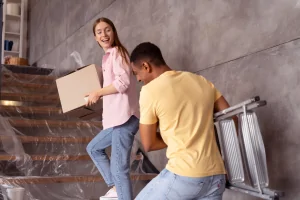
Stairs require double attention. Secure the steps with non-slip cardboard to prevent falls, and cover the handrail with a protective layer. This is where appliance damage most often occurs when being carried down.
Door frames must be protected before moving large furniture out. Two pieces of rigid cardboard or corner guards are enough to prevent chipped paint.
In narrow spaces, move large pieces in an upright position and maintain constant communication with the person in front. One wrong move in a tight hallway can cause scratches instantly.
Do not place heavy or sharp-edged items directly on the floor. Set them on a protective layer, even for a few seconds. It’s always easier to prevent damage than to repair it.
Safe Lifting and Carrying Techniques
- Lift with your legs, not your back. Bend your knees, keep your back straight, and push through the floor with your feet.
- Keep the item as close to your body as possible. This reduces strain and helps you control the weight.
- Never twist your torso while holding weight. If you need to change direction, move your feet — not your spine.
- Use dedicated moving equipment: dollies, lifting straps, rolling platforms. They prevent injuries and reduce effort.
- For long or very heavy items, work with a partner. Continuous communication matters more than strength.
- Check your grip before lifting. Handles, corners, or edges can slip if not held correctly.
- Do not force items that get “stuck” in a doorway or on the stairs. Adjust the angle — don’t push.
- Center the weight. If the item is unbalanced, stabilize the heavier side before lifting.
- Clear the path before you start lifting. The space must be completely free of obstacles.
- Do not move tall items without a stabilizing hand at the top. For refrigerators, wardrobes, or shelving units — tilt slightly and maintain control at the top.
- Take short breaks when handling very heavy items. Fatigue is one of the main reasons accidents happen.
How to Properly Arrange Items in the Moving Truck
Correctly arranging items in the truck reduces the risk of structural damage, scratches, shifting during transport, and uneven pressure on boxes and furniture.
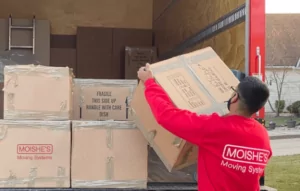
Weight is distributed from bottom to top
- Heavy items form the base: appliances, dense boxes, compact furniture.
- Light items are placed on the upper levels.
Large pieces are secured to the truck walls
- Vertical furniture is aligned against the wall.
- Tie-down straps are used for lateral stabilization.
Sturdy boxes go in the center
- They create a stable “core.”
- Avoid placing deformed boxes in load-bearing zones.
Fragile items go on top — and separately
- Boxes with glasses, plates, frames, or electronics should never be stacked on heavy objects.
- Leave a buffer space between fragile items and large pieces.
All gaps must be filled
- Any empty space allows items to shift during braking.
- Textiles, blankets, pillows, or corrugated cardboard help stabilize the load.
Large appliances must be secured individually
- Refrigerator, washing machine, dryer — each must be strapped separately.
- Doors must be locked or secured before loading.
Keep the truck entrance clear
- Nothing should be placed near the access door.
- Prevents items from falling out when opening.
Weight must be distributed evenly
- The left and right sides must be balanced.
- Avoid concentrating heavy mass in a single point.
Deformed boxes = on top only, and only with light contents
- Never use them at the bottom.
- Prevents crushing and collapse.
Final check
- Visual inspection of all straps.
- Test stability with a gentle sideways push.
- Eliminate all visible gaps.
These techniques are standard in professional moving and significantly reduce the risk of damage during transport.
12-Point Checklist Used in Professional Moves
- Boxes properly sealed and labeled on two sides.
- Large pieces secured with tie-down straps.
- Refrigerator and appliances have their doors locked.
- The path to the exit door is completely clear.
- Floors and walls are protected in contact areas.
- Nothing is left on the edge of the truck ramp.
- Empty spaces in the truck are filled with textiles or blankets.
- Fragile items are placed on the upper level.
- Stability is checked with a gentle sideways push.
- All movable drawers are secured or wrapped with stretch wrap.
- No cables, loose items, or detached parts are left on the floor.
- The last box loaded should not block access to the truck entrance.
What to Do After the Move (Inspection & Documentation)
Zone 1: Large Items
- Quickly check each bulky piece. Corners, edges, and the areas that touched walls are the first places where damage may appear.
Zone 2: Appliances
- Inspect the doors, seals, and sides. Wait a few hours before turning on the refrigerator, then test its basic functions.
Zone 3: Fragile Items
- Open the boxes labeled “fragile” before the others. If you hear unusual noises or see torn packing material, check them immediately.
Zone 4: Walls and Door Frames
- Walk along the walls with side lighting. Fine scratches and scuff marks are easier to see. Document them before placing the furniture back in position.
Zone 5: Boxes and Packing Materials
- Don’t throw away any materials until you are sure everything is in good condition. They’re necessary in case you need to file a claim.
Zone 6: Documentation
- Take clear photos, close-up details, and a wide shot. Everything should be recorded on the same day. This is standard both for professional moves and for insurance.
Zone 7: Reporting
If you worked with a moving company, report any damage as soon as possible. Many companies require reporting within the first 24–48 hours after delivery, according to the contract, so make sure you also check the conditions listed in your paperwork.
Green Moving: A Responsible, Practical, and Safer Choice for Your Move
A sustainable move means smarter choices, better materials, and an overall cleaner experience for you and for the environment. From what we see every day in the field, most clients end up appreciating that their move becomes more organized, safer, and even cheaper in the short term.
Green moving means, in short, reducing waste and using durable, reusable materials instead of single-use supplies. And that’s where we come in: Moishe’s offers options that make a real difference in logistics and in the safety of your belongings.
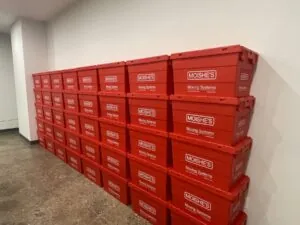
Real benefits of a green move:
- reusable packing materials (strong, clean, stable, with none of the tearing risks of cardboard)
- green bins and containers available for rent, which instantly reduce waste
- better protection for fragile items thanks to durable containers
- clearer organization, because every container stacks perfectly during transport
- a cleaner moving process — no scraps, no torn corners, no wasted tape
- lower short-term costs (you use far fewer consumables)
- less stress on moving day — everything is more orderly, stable, and easy to verify
For many of our clients, the biggest advantage wasn’t the environmental aspect itself. The fact that their items arrived better protected — without moisture, without impact marks, and without the risk of a box collapsing on the stairs or in the truck — was the deciding factor.
If you want a more efficient and less chaotic move, green moving is an excellent solution. And if you want to put it into practice quickly — whether with green containers or with alternatives to traditional packing materials — the Moishe’s team can help you with everything you need, at your exact pace.
Frequently Asked Questions
-
How do you prevent boxes from breaking during a move?
Use sturdy boxes, don’t overpack them, and reinforce the bottom with wide tape in an “H” pattern. Place heavy items at the bottom and fill all gaps with crumpled paper to avoid internal pressure.
-
How do you properly protect a fragile item?
Wrap it individually, add 1–2 cushioning layers, and secure it in a box with no empty spaces. Plates should be placed vertically, glasses in sleeves/tubes, and electronics only in the correct position.
-
What materials are essential for a safe move?
Thick moving blankets, stretch wrap, bubble wrap, corner cardboard, sturdy boxes, packing tape, and cushioning materials (paper padding or crumpled paper).
-
How do you prevent furniture from getting scratched?
Cover surfaces with thick blankets and secure them with stretch wrap. Protect corners separately with cardboard or foam. Large furniture should be partially disassembled.
-
How do you protect floors on moving day?
Use pathways made of blankets, cardboard, or special non-slip floor protection. Avoid dragging furniture; lift it or use a moving dolly.
-
How do you prevent appliances from getting damaged?
Wrap them with blankets, secure the doors with light tape, and transport them in the proper position (e.g., refrigerators upright). Tie the cables and avoid direct contact with the truck walls.
-
How do you protect paintings and mirrors?
Place a rigid cardboard sheet on the front surface, then wrap in bubble wrap and a moving blanket. Transport them vertically and secure them between stable items.
-
Why do plates break during a move?
Because they’re placed horizontally or gaps are left inside the box. Vertical placement + full cushioning + sturdy boxes = the safest method.
-
How do you prevent TV damage?
Move it upright, protect the screen with hard cardboard, wrap it in a blanket, and secure it with stretch wrap. In the truck, it should rest between soft items (mattresses, sofas).
-
What if you don’t have professional materials?
Use thick clothes, towels, blankets, cardboard from old boxes, and crumpled paper. The priority is full cushioning and preventing movement inside the box. Or you can buy professional materials or rent reusable plastic moving bins.
In conclusion, preventing damage during a move comes down to two things: using the right materials and applying the right techniques with care. Sturdy boxes, professional moving blankets, corner protectors, and properly securing items inside the truck prevent the majority of incidents. If you’re handling a large volume or have heavy, fragile, or hard-to-move items, a professional team makes all the difference.
And if you need fast, organized, and reliable help, the Moishe’s Moving team can take care of the entire process, from packing to transport to placement, so your move stays damage-free and stress-free!
Get a Free Moving Quote Today